01
Built around people
Technology should make everyday work easier. We simplify routine processes so doctors, nurses, technicians and administrators can spend more time doing what matters.
Mediquity Technologies builds connected platforms for hospitals, laboratories, blood banks, pharma and public health - shaped by a team that has worked inside healthcare for over two decades.

Mediquity Technologies Pvt. Ltd. was founded in 2021 with a clear understanding of how healthcare actually works - because our team has been working in healthcare long before we started building technology for it.
With over two decades of experience across healthcare BPOs, hospitals, healthcare facilities and government health programmes, our founding team has seen the challenges from the ground up. We have managed real operations, worked with healthcare teams and delivered large-scale programmes. That experience now shapes the technology we build.
Today, Mediquity is a team of 60+ technology and healthcare domain experts, working with hospitals, laboratories, blood banks, pharmaceutical organisations and public-health programmes across India.
When you have managed patient registrations at a busy hospital or coordinated healthcare programmes across hundreds of facilities, you understand where things slow down, where information gets missed and where small gaps can become bigger problems.

We bring that understanding into our products.
Our platforms are designed around real healthcare workflows, built for the people who use them every day, and developed to make work simpler - not add another layer of complexity.
We build connected technology for different parts of the healthcare ecosystem - each platform works on its own and connects to the rest.

Patient records, OPD/IPD, billing, pharmacy and everyday hospital operations.

Sample management, reporting and laboratory workflows.

Donor management, inventory and end-to-end traceability.
Turning handwritten notes into structured digital records, in real time.

Technology that helps pharmaceutical organisations manage regulatory requirements.
Large-scale digital systems for government and PPP healthcare programmes.
Together, these solutions help healthcare organisations move towards more connected, efficient and paperless operations.
The way we design, build and roll out our platforms comes from years spent inside healthcare operations.
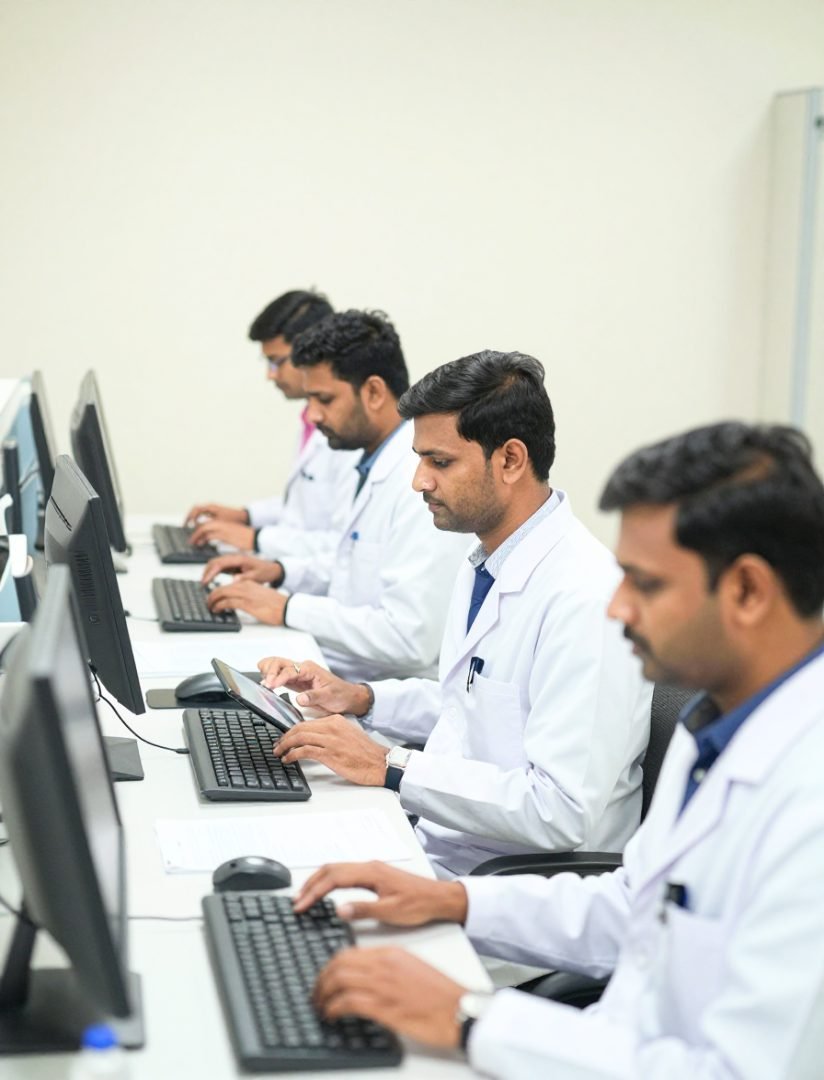
Technology should make everyday work easier. We simplify routine processes so doctors, nurses, technicians and administrators can spend more time doing what matters.
Healthcare involves people, departments, approvals, regulations and thousands of daily transactions. Our systems are built to work with that complexity.
Healthcare data demands a high level of trust. We build our platforms with security, interoperability and healthcare standards in mind from the beginning.
Whether it is a single healthcare facility or a large public-health network, our solutions can adapt to different needs, workflows and scales.
Every day our platforms carry real registrations, real reports and real care decisions across India.
Our work is backed by recognised programmes, certifications and healthcare standards.
Recognised under the Startup India programme
3 products certified under ABDM
Featured as an Oracle Global Case Study
Working towards CMMI Level 5
Our platforms are developed in alignment with National Health Authority (ABDM) guidelines and relevant healthcare standards, including HL7, HIPAA and DICOM.
We believe technology has a role to play beyond digitising processes.
At Mediquity, we build technology with a simple purpose: to make healthcare work better. Our solutions come from real experience, real challenges and a clear understanding of the people who use them every day.
The history matters. We don’t build software and hope it fits healthcare — we have worked inside health BPOs, hospital departments and diagnostic networks, and every platform we ship has been shaped by that experience.
That is why our systems assume the realities of a working hospital: interrupted shifts, mixed paper and digital records, patchy connectivity, and staff who cannot stop to learn new software mid-round.